The Future of Supply Chain Talent: Hiring, Upskilling, and Managing Teams Across Borders
Supply chains are becoming more connected, more data-driven and increasingly international. As operations expand across multiple sites and markets, the demands placed on supply chain teams are changing as well. Businesses need people who can work with new technologies, collaborate across functions and respond quickly when disruption occurs. The future
Finding those capabilities is not always straightforward. Labour shortages remain a challenge in many areas, while some of the most valuable skills depend on experience and knowledge that cannot easily be recruited from outside. At the same time, organisations are exploring international hiring and more flexible ways of building teams.
So workforce planning now needs to sit closer to operational planning. It has to consider which roles should be recruited locally, where international hiring could help, and which capabilities are better developed from within the business.
For supply chain leaders, the challenge is practical. Teams need enough people to keep operations moving today, while also building the skills needed for a more digital, distributed and resilient supply chain tomorrow.
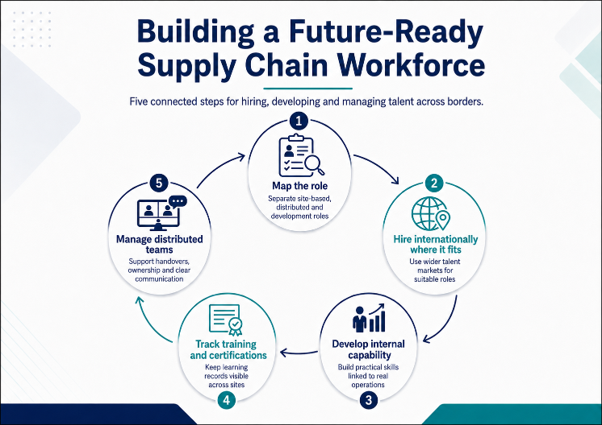
Future Ready Supply Chain Workforce
Start With the Work Behind the Role
It is easy to assume that a vacancy should be filled in the same way as the last one. Someone leaves, a replacement is needed, and the search begins.
But supply chain roles are rarely that simple.
The same job title can mean very different things depending on the business. A supply chain coordinator in one organisation may spend much of the day dealing with warehouse issues, transport updates and customer queries. In another, the role could focus on reporting, planning support and supplier communication.
That distinction matters because not every task needs the same type of person, location or development route.
Rather than starting with where to recruit, it makes more sense to start with the activities involved. Some responsibilities rely heavily on local knowledge or physical presence. Others depend more on systems, documentation and communication, which makes them easier to support from another site or country.
A useful starting point is to divide roles into three groups:
- site-based roles that need local presence, such as shift leadership, maintenance, warehouse operations and transport coordination
- distributed roles that can support the wider network, such as planning analysis, procurement administration, supplier communication and documentation
- knowledge-heavy roles that are often best developed internally, such as process owners, systems champions, compliance leads and future operations managers
This helps avoid two common mistakes. Some organisations treat every vacancy as a local hiring problem, even when the work could be supported from elsewhere. Others move too quickly towards distributed work without considering handovers, escalation routes or local operational knowledge.
The work should shape the route. A team looking at future leadership in supply chain operations may need to build deeper internal capability through routes such as supply chain management courses. A business struggling to find analytical or multilingual support may need to widen the talent pool beyond its immediate location.
Often, both routes are needed at the same time.
Use International Hiring Where the Work Can Travel
Cross-border hiring can be valuable in supply chain, particularly when local talent is difficult to find or the organisation needs capabilities that are not tied to a specific site.
Functions such as planning support, data analysis, procurement administration, customer operations and regional supplier communication can often be delivered effectively across borders. These roles still require structure and accountability, but they do not always depend on daily physical presence. However, international hiring only works when the employment arrangements are properly considered.
Recruiting in another country introduces questions around contracts, payroll, tax, benefits and local employment regulations. For supply chain businesses that want to access overseas talent without establishing a legal entity, working with an EOR company can provide a practical way to manage international employment requirements.
International hiring can expand access to talent. It also increases the need for clear processes, because distance tends to expose any gaps in how work is managed.
Build Internal Skills Where Company Knowledge Matters
In many supply chain functions, the knowledge that creates the most value is built over time and is closely tied to the way the business operates. Replacing that knowledge from outside can be difficult, even when experienced candidates are available.
Take a warehouse supervisor as an example. Their effectiveness often comes from understanding far more than the job description suggests. They know how the site runs during peak periods, which carriers need closer attention, where bottlenecks usually appear and which customer requirements create the biggest operational risks. Much of that knowledge is practical rather than documented.
Generic objectives such as “improve leadership” or “increase digital capability” rarely provide enough direction. Training works best when it addresses the points where teams actually struggle. Introducing a warehouse management system, for instance, may require focused learning around exception handling, scanning accuracy and shift reporting rather than a simple software overview. Structured learning can support that progression. Development pathways in areas such as purchasing and procurement, transport and logistics and warehouse management provide a more consistent approach than relying only on experience gained under pressure.
Experience remains valuable. But experience on its own does not always create capability. Without structured development, important gaps can stay hidden until the operation is tested.
Keep Training Visible Across Sites and Teams
Upskilling becomes difficult to manage once teams are spread across sites, shifts, regions or countries. At a small scale, managers may know who has completed which training. They may remember who can use a system confidently, who needs refresher learning and who is ready for the next step.
Using training administration software can make it easier to coordinate course scheduling, attendance records, certificates and reporting, especially when learning takes place across multiple locations or delivery formats. For supply chain teams, this visibility is valuable because training often has a direct impact on compliance, safety, productivity and service quality.
There is already strong thinking around measuring the return on investment in supply chain training programmes. The next step is making sure the business can actually see what training has happened, what changed afterwards and where the gaps still sit.
Manage Distributed Teams With Fewer Assumptions
Managing distributed teams becomes more important as organisations combine international
What helps is stronger operating discipline. Clear ownership. Defined escalation routes. Documented decisions. Regular capability reviews. And enough shared context for each team to understand how its work affects the next part of the chain.
This matters particularly for organisations using remote or distributed talent. The flexibility can be a real advantage, and remote talent is already reshaping the modern supply chain workforce. But the businesses that gain the most from these arrangements are usually the ones that make processes easier to follow and information easier to share.
Bring Hiring and Upskilling Into the Same Conversation
Workforce planning in the supply chain rarely belongs to one team. Recruitment, training, operations and finance all influence the decisions, and the effects are usually felt across the business rather than in isolation. A shortage of planners affects service levels. Weak onboarding affects productivity. Delayed training can slow down the adoption of new systems or processes.
The companies that handle this well will not just fill vacancies faster. They will build teams that can adapt, collaborate across locations and continue delivering results when the pressure on the supply chain increases.

Guarantee success in your supply chain with IoSCM. Find out how our qualifications, resources, support and expertise can help you. Call 0800 1422 522 today.