
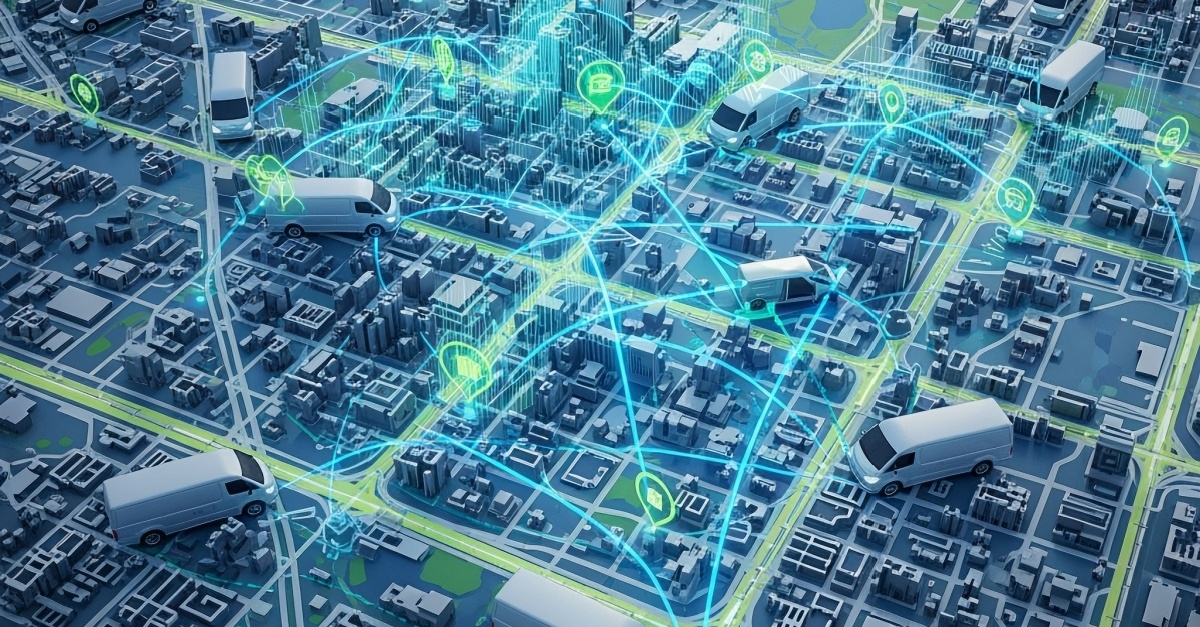
How AI and Predictive Analytics Are Transforming Route Optimisation in Logistics
The logistics industry is undergoing a structural shift where efficiency is no longer defined solely by cost minimisation, but by adaptability under uncertainty. Traditional route optimisation once focused on static constraints—distance, fuel usage, and delivery windows—but today’s supply chains operate in a state of continuous disruption. From volatile demand patterns to unpredictable infrastructure bottlenecks, logistics systems now require intelligence that evolves in real time. This is where AI-driven route optimisation transitions from a tactical tool into a strategic capability.
Forward-thinking organisations are increasingly partnering with a logistics software development company to design systems that can interpret signals beyond obvious variables. These systems ingest behavioural, environmental, and operational data streams simultaneously, enabling logistics leaders to make decisions not just faster, but fundamentally better. The emphasis is no longer on finding the shortest path—it is on identifying the most resilient and context-aware route.
What is rarely discussed is that route optimisation is becoming a proxy for overall operational intelligence. Companies that invest in predictive routing systems often unlock broader insights into workforce efficiency, asset utilisation, and even customer behaviour patterns. In this sense, AI-powered route optimisation becomes a gateway to enterprise-wide transformation, rather than an isolated improvement initiative.
The Evolution of Route Optimisation: From Static Rules to Intelligent Systems
Route optimisation has historically been grounded in deterministic models—algorithms that assume stable inputs and predictable conditions. Early systems relied heavily on classical optimisation problems such as TSP and VRP, which, while mathematically robust, fail to capture the chaotic nature of real-world logistics. These models treat variability as noise, rather than as a defining characteristic of operations.
The transition towards intelligent systems began with the introduction of telematics and IoT, enabling real-time tracking of vehicles and shipments. However, visibility alone was not enough. The real shift occurred when organisations began embedding predictive analytics into routing workflows. Systems evolved from reactive tools into proactive engines capable of forecasting disruptions before they occur.
A rarely emphasised insight is that modern routing systems function as decision orchestration layers rather than simple optimisation engines. They must balance multiple competing objectives across operations, compliance, and customer expectations. This evolution represents a move from static efficiency to adaptive, context-aware intelligence.
What AI and Predictive Analytics Really Mean in Logistics Contexts
AI in logistics is often misunderstood as simple automation, but in practice, it represents a sophisticated decision-making framework. It combines machine learning models, optimisation algorithms, and real-time data processing to generate routing strategies that adapt dynamically to changing conditions.
Predictive analytics introduces a forward-looking dimension. Instead of optimising routes based on current conditions alone, systems anticipate future states—traffic congestion, delivery delays, and demand fluctuations. This allows logistics providers to act proactively rather than reactively.
A deeper, less discussed layer is the fusion of predictive and prescriptive analytics. Predictive models identify what is likely to happen, while prescriptive systems recommend the best course of action. When integrated, these capabilities enable systems to not only foresee disruptions but also autonomously respond to them.
For additional technical perspective, resources such as Google’s Machine Learning documentation and AWS predictive analytics guides provide insight into how such systems are designed at scale.
Ultimately, AI in logistics augments human decision-making with probabilistic intelligence, enabling organisations to operate with a level of foresight that traditional systems cannot achieve.
Core AI-Driven Capabilities Transforming Route Optimisation
AI-driven route optimisation introduces capabilities that fundamentally reshape logistics operations. One of the most impactful is dynamic route recalculation, where systems continuously adjust routes based on real-time inputs such as traffic, delays, and vehicle performance.
Demand forecasting is another critical capability. By analysing historical and external data, AI systems predict shipment volumes and distribution patterns, allowing for better load planning and reduced inefficiencies.
Multi-constraint optimisation represents a major leap forward. AI systems can simultaneously evaluate fuel costs, delivery deadlines, driver availability, and regulatory requirements—something traditional systems struggle to handle at scale.
An often overlooked capability is autonomous decision-making. Advanced systems can make routing decisions independently in high-frequency scenarios, reducing reliance on manual intervention and increasing operational speed.
Together, these capabilities transform route optimisation into a continuous, intelligence-driven process.
The Hidden Engineering Challenges Behind AI-Powered Route Optimisation
Despite its advantages, AI-driven route optimisation introduces significant engineering complexity. One major challenge is data integration. Logistics data is often fragmented across multiple systems, requiring robust pipelines to unify and normalise information.
Model accuracy and adaptability present another challenge. Machine learning models must continuously evolve to reflect changing conditions, requiring ongoing training and validation processes.
Latency is also critical. Real-time optimisation demands systems capable of processing large data volumes within milliseconds, often necessitating distributed architectures and edge computing.
Explainability is a less obvious but crucial factor. Logistics managers must understand why certain routing decisions are made, especially in high-risk scenarios. Without transparency, trust in AI systems can be compromised.
These challenges highlight that successful implementation requires more than algorithms—it demands comprehensive engineering expertise.
Architecture Patterns for Building AI-Driven Route Optimisation Systems
Building effective AI-driven routing systems requires a well-structured architecture. The foundation is the data layer, responsible for ingesting and processing data from IoT devices, APIs, and internal systems.
Above this sits the machine learning and optimisation layer, where predictive models and algorithms generate routing decisions. Tight integration between these components is essential for seamless performance.
Integration with existing platforms such as TMS and ERP systems is another key consideration. This requires scalable APIs and middleware to ensure interoperability.
Edge computing is increasingly important for reducing latency and enabling faster decision-making closer to the data source.
A robust architecture ensures scalability, resilience, and the ability to handle the growing complexity of logistics operations.
Business Impact: From Cost Reduction to Strategic Differentiation
AI-driven route optimisation delivers value beyond cost savings. While reductions in fuel consumption and operational efficiency are immediate benefits, the long-term impact lies in competitive differentiation.
Improved delivery accuracy enhances customer satisfaction, which is critical in today’s on-demand economy. Real-time updates and precise delivery windows have become baseline expectations.
Scalability is another major advantage. AI systems allow logistics operations to grow without proportional increases in complexity or cost.
Perhaps most importantly, AI enables new business models. From same-day delivery to dynamic pricing, organisations can innovate in ways that were previously unattainable.
Route optimisation thus becomes a strategic driver of growth and innovation.
Real-World Use Cases: Where AI Route Optimisation Delivers the Most Value
AI-driven route optimisation is already transforming multiple logistics domains:
| Use Case | AI Application | Business Impact |
| Last-Mile Delivery | Real-time route adjustment | Faster deliveries, lower costs |
| Fleet Management | Predictive routing & maintenance | Better asset utilisation |
| E-commerce Logistics | Demand forecasting | Improved planning and efficiency |
| Cross-Border Logistics | Multi-modal optimisation | Reduced delays and disruptions |
| Cold Chain Logistics | Condition-aware routing | Lower spoilage and compliance risk |
Last-mile delivery remains the most complex and expensive segment, making it a key focus for AI optimisation. Fleet management and cross-border logistics also benefit significantly from predictive capabilities.
These use cases highlight the flexibility and scalability of AI-driven routing systems.
Why Off-the-Shelf Solutions Fall Short for Advanced Logistics Needs
Off-the-shelf route optimisation tools often fail to meet the needs of complex logistics operations. They are designed for general use cases and lack the flexibility required for specialised scenarios.
One limitation is poor integration with existing systems, which reduces their effectiveness. Another is limited scalability, as these tools struggle to handle increasing data complexity.
Custom AI-driven solutions provide greater flexibility, scalability, and alignment with business goals. They enable organisations to incorporate unique constraints and optimise performance at a deeper level.
Choosing custom development is therefore a strategic investment rather than a technical upgrade.
Future Outlook: Toward Autonomous and Self-Optimising Logistics Networks
The future of logistics is moving towards autonomous systems capable of end-to-end decision-making. AI will increasingly handle route planning, execution, and optimisation without human intervention.
Digital twins will play a key role, allowing organisations to simulate logistics scenarios and optimise strategies before implementation.
Continuous learning systems will further enhance performance, enabling logistics networks to adapt in real time.
These advancements will create more resilient, efficient, and intelligent supply chains.
